The majority of organizations try to optimize their delivery...
without realizing the problem starts long before the IT teams.
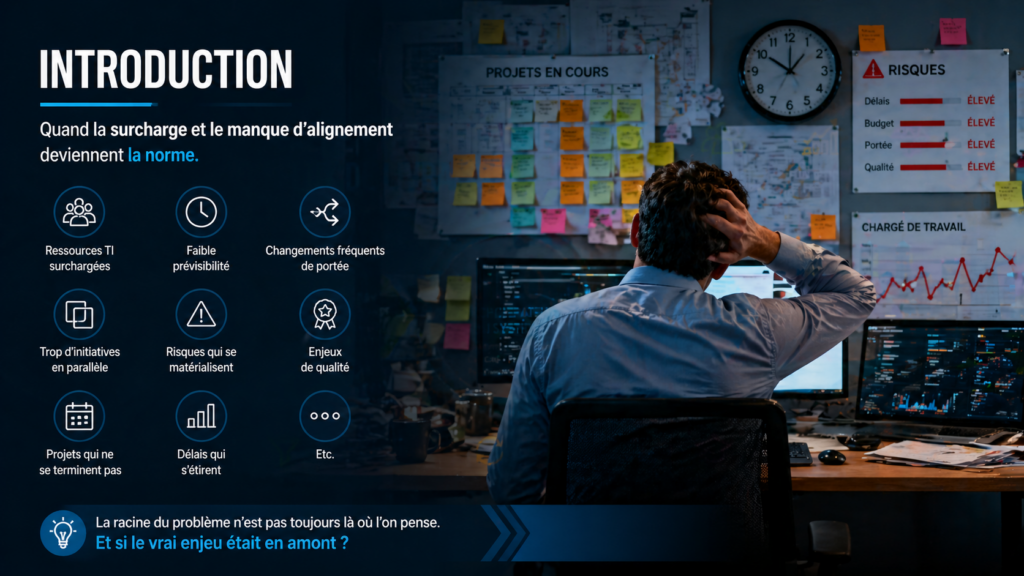
Many organizations face the same symptoms:
- Overloaded IT resources
- Low predictability
- Runtime scope changes
- Projects that never end
- Quality challenges
- Too many initiatives at the same time
- Projects with stretching deadlines
- Risks that materialize more often than not
These symptoms are often interpreted as a delivery problem.
In most cases, it's more of an upstream problem:
The work was not “ready” to enter the system
A misalignment between «Business» demand and actual «IT» delivery capacity»
The real problem: a poorly aligned request from the start
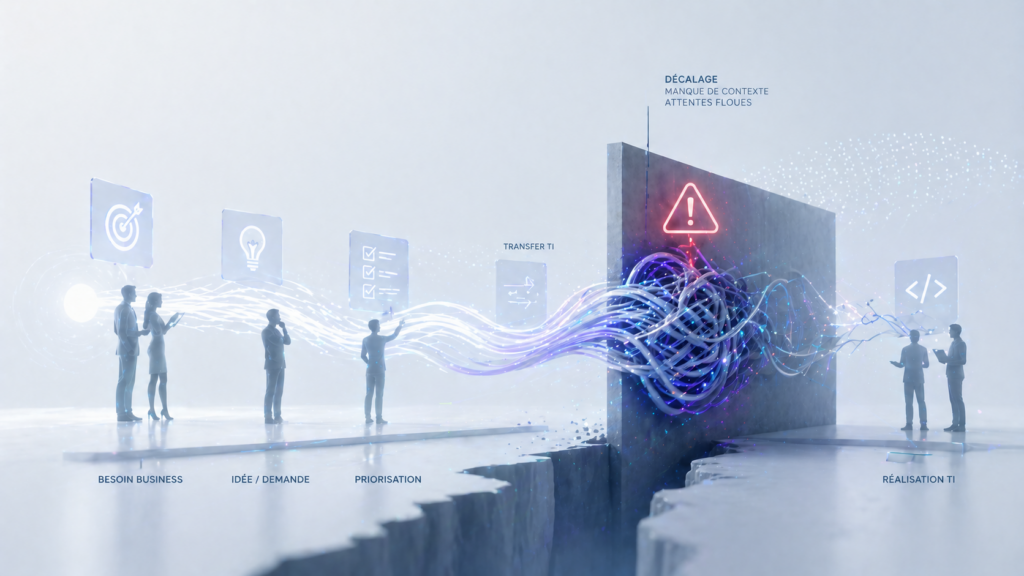
When IT initiatives are launched without a clearly defined business need...
The organization creates a system where the flow is fueled by ambiguity.
This ambiguity never disappears.
👉 She moves from end to end... and gets paid further down the delivery pipeline
Execution debt
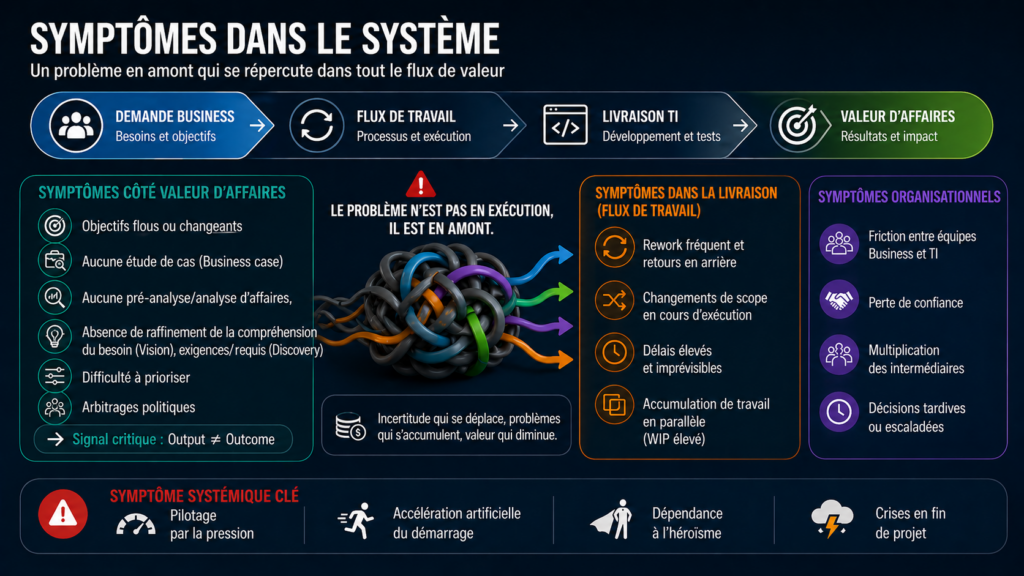
Symptoms in the system
Symptoms in the workflow
- Frequent rework and setbacks
- Runtime scope changes
- Long and unpredictable delays
- High Work in Progress (WIP)
The work was not ready to enter the system.
Variability is introduced at the entry point of the PMO delivery flow.
Business value side effects
- Vague or changing objectives
- No pre-analysis/business analysis,
- No case studies
- Lack of refinement in understanding the need (Vision), business requirements (Discovery)
- Difficulty prioritizing
- Political arbitrage
Signal critique: Output ≠ Outcome
Organizational symptoms
- Friction Business / TI
- Loss of confidence
- Multiplication of intermediaries
- Late decisions
The system is becoming unresponsive and inefficient
Key systemic symptom
- Pressure Pilotage (Who shouts the loudest in the room?)
- Artificial startup acceleration
- Heroism addiction
The problem is not in execution
He is upstream
🔎 Quick diagnostic:
If you observe:
- many projects in progress
- few deliverables completed
- frequent changes in priorities
Your problem is likely upstream, not in execution.
Diagnostic: A request quality issue
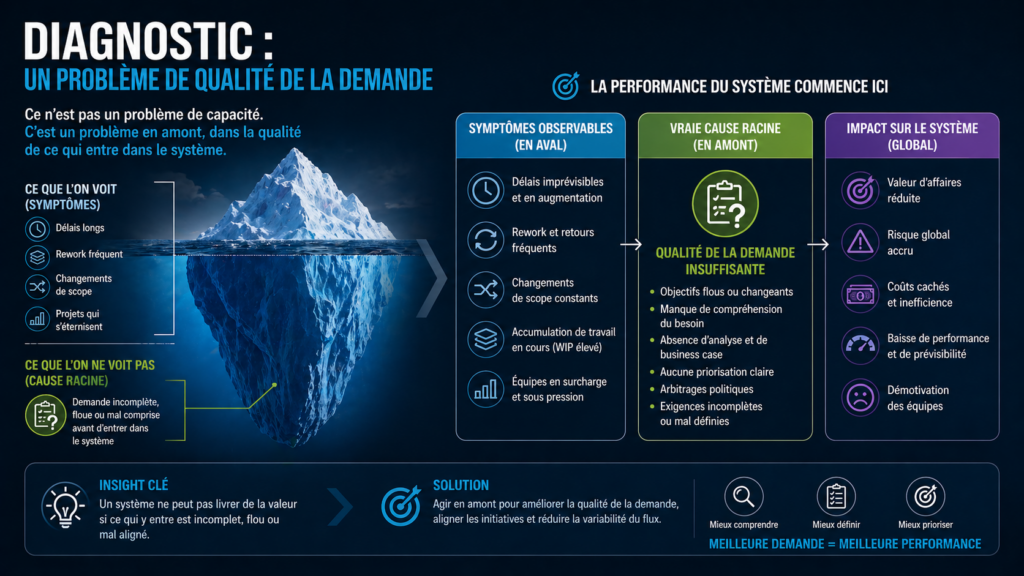
This is not an execution problem
This is a problem with Demand Quality
This translates to:
- Absence or weakness of the upstream process
- Lack of Definition of Ready
- Business/delivery decoupling
- Under-capacity in discovery / analysis
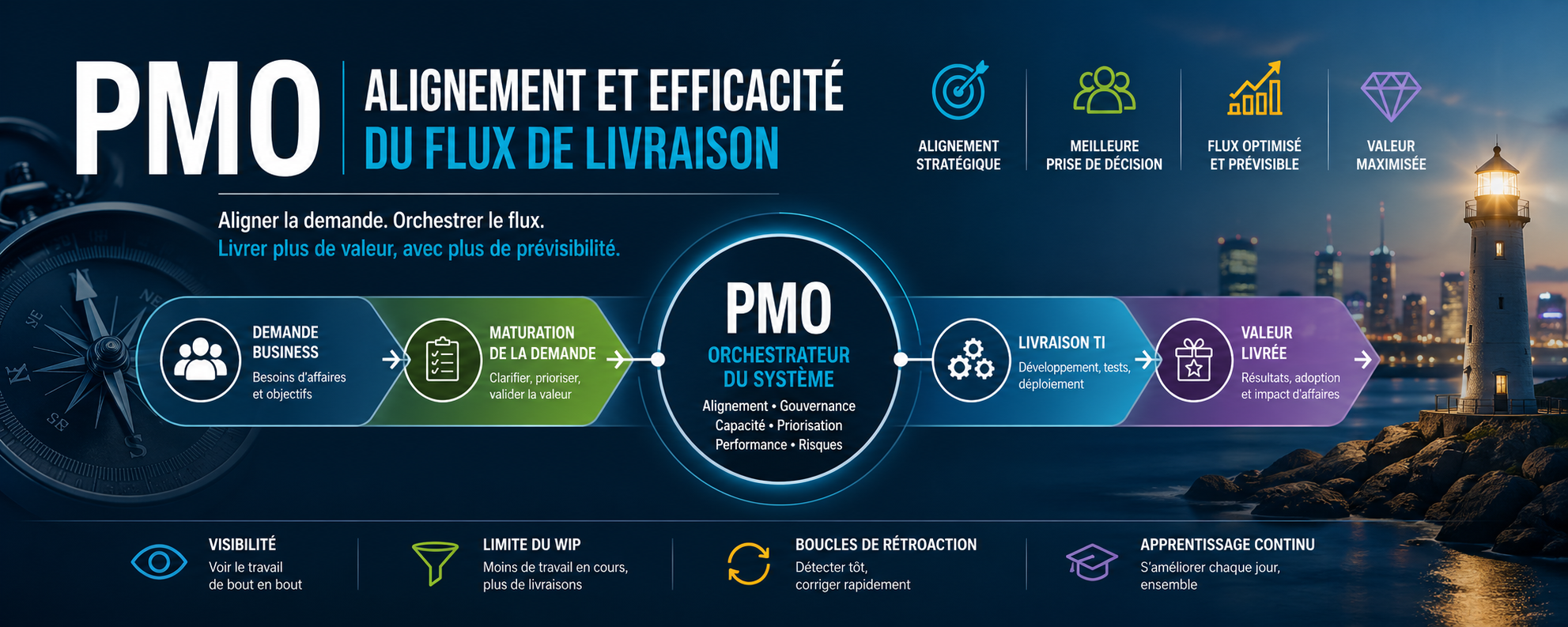
The PMO: Orchestrating Alignment Between Business and IT – the end-to-end flow
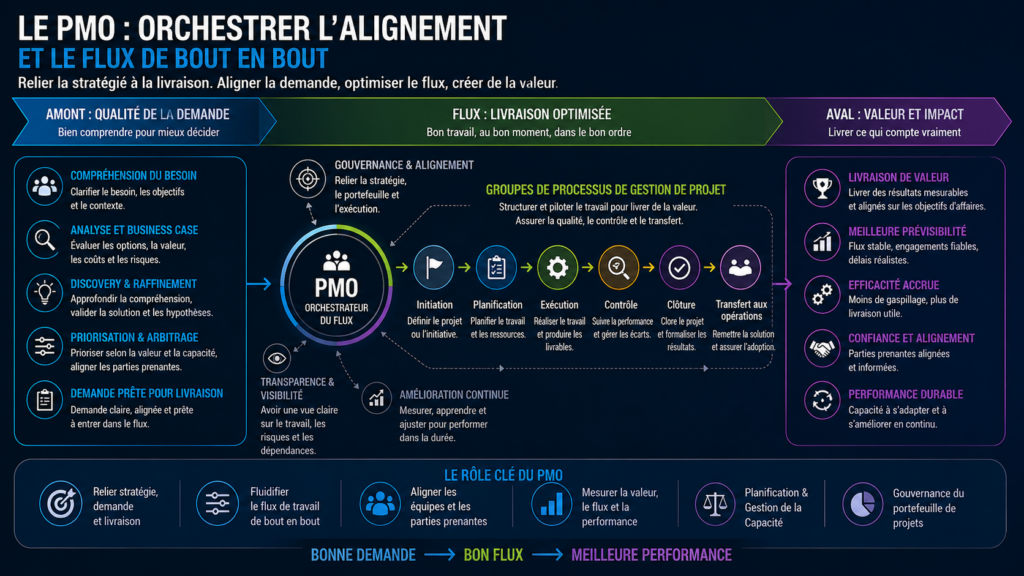
Faced with this diagnosis, one question becomes central:
Who structures the demand, aligns priorities, and stabilizes the delivery flow?
👉 This is precisely the role of a modern PMO
A high-performing PMO is not limited to:
- control portfolio costs
- produce statuses
- standardize templates
It acts like a Delivery system orchestrator
He connects:
- Business strategy
- the demand (upstream)
- downstream delivery capacity
👉 to create a coherent, aligned, and high-performing flow
Aligning «Business» and IT is the key to success!
Its value
- direct investments
- structure decisions
- align demand with capacity
- Improve delivery performance
- Anticipate and manage risks
He does not manage projects
👉 He manages a system
The Pillars of a Value-Creating PMO
Strategic Alignment
Ensure the delivery pipeline is fed by the right priorities
2. Effective Governance
Structure without being burdensome
3. Tailored Standardization
Reduce variability
4. Performance and Value Management
From output to outcome
5. Capacity Development
Strengthen organizational maturity
6. Change and Knowledge Management
Promote learning
7. Executive Support
Provide a strategic anchor
Systems thinking
Without this structuring role:
- The upstream remains chaotic.
- the demand remains unstable
- the downstream absorbs complexity
Result:
- Surcharge
- deadlines
- loss of value
👉 The PMO becomes the balancing point between:
Strategy and Execution
If this type of situation reflects your reality, it's usually a sign that a flow realignment is needed.
First levers for improvement

Before any major transformation, certain simple actions help to stabilize the system:
Optimize the end-to-end flow: from ideation (or business request) to deployment (Operations/Production)
- Prioritize
- Make Work Visible (WIP)
- Limit Work in Progress (WIP) «Stop Starting. Starting Finish”
- Clearly formulate policies (mechanisms)
Define a clear entry point (Commitment Point)
- “Ready for Delivery” criteria aka Definition Of Ready (DoR)
Amplify short feedback loops
- Reverse direction of exploitation/production towards other upstream functions (Business)
- The workflow should not be solely downward, it must also allow for quick feedback.
- We aim to quickly detect problems (quality, incidents, performance, security),
- Make problems visible and fix them early through collaboration
Amplify short feedback loops
A high-performance system doesn't just deliver.
He learns and improves.
This implies:
- Avoid repeating the same mistakes and improve the system sustainably
- Continuous improvement
- Time Reserved for technical debt reduction and reliability
- “No name, blame, shame, or games”
5. Some metrics to monitor
You can't improve what you don't measure.
- Lead Time
- Delivery rate
- Flow Efficiency
- Failure Demand
- Discard/Abort Rates
- Etc.
Goal: stabilize the flow before accelerating it
Conclusion – From Understanding to Execution

Understanding that your problem is related to the quality of the request and the mastery of your workflow is a first step.
👉 But true value is created when this understanding translates into Concrete actions on your delivery system.
In practice, this involves:
- Help structure your upstream (Identification – Discovery – Prioritization)
- Aligning your initiatives with your business strategy
- Make your workflow visible end-to-end
- Balance demand with your actual capacity
- Improve delivery predictability and quality
This is precisely where many organizations hit their limits.
Not for lack of good intentions or willingness...
but for lack of Structuring framework, method, and support tailored to their reality.
How can I assist you?
I assist organizations in:
- Regain control of their delivery flow
- Structure their PMO as a performance lever
- Improve their ability to predictably deliver value
Whether it's for:
- Optimize Your PMO and Portfolio Management
- Structure your upstream request pipeline
- Stabilize your delivery (downstream)
- or support a Lean / Agile transformation
The objective remains the same:
Align, execute, and perform within a coherent and controlled system
Successful organizations don't just deliver faster by accident.
They structure their system from end to end.
Approach
My approach combines:
- Lean / Kanban (flow and capacity management)
- Systems thinking (end-to-end)
- Project management practices adapted to the real-world context
- Results-oriented field support
👉 Without a “big bang” transformation”
👉 Without unnecessarily increasing the weight of your structures
With an evolutionary and pragmatic approach, aligned with your organization
Expected result
- reducing delays
- improving predictability
- reduction of rework
- best use of capacity
- increased value delivered
Next step
If these issues resonate with your reality:
We can exchange for:
- diagnose your current situation
- Identify your main points of friction
- define concrete short-term actions
Because in the end:
performance doesn't come from doing more…
but to better structure what needs to be done.
Let's discuss your current situation and quickly identify the most impactful areas for improvement.
About the author

With over 20 years' experience in Information Technology management, Éric Auger helps companies accelerate value delivery and optimize organizational performance. As an IT consultant specializing in project management, Lean Six Sigma Green Belt practitioner, Kanban management expert and agility coach, I combine strategy, tactics and operations to maximize your competitiveness in the digital age.
Passionate about digital transformation, I support organizations in optimizing their value streams, thus guaranteeing a sustainable competitive advantage. I also enjoy sharing my expertise and helping professionals strengthen their project management and agility skills.
Follow me for practical advice and proven strategies to make your projects a success.